Can You Put Car Oil in a Motorcycle? The JASO T903 Answer
Updated July 2026The wet-clutch chemistry that makes this a real question, the JASO standard that answers it, and the exact label language — “Energy Conserving,” moly friction modifiers — that fails a shared-sump engine.
Why your engine and your gearbox share the same oil
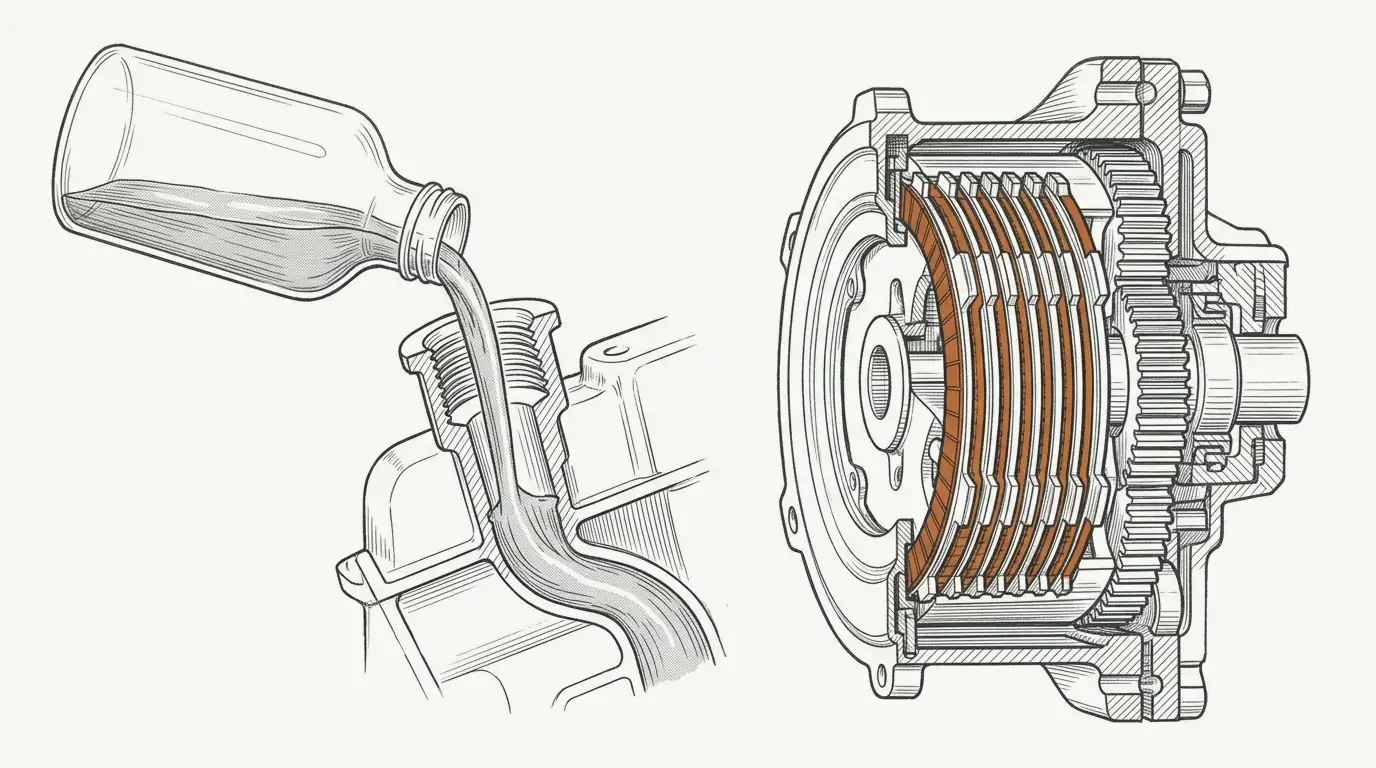
Most cars keep engine oil and transmission fluid in two separate systems. Most motorcycles don’t: the crankcase, gearbox, and wet clutch share one sump, so whatever you pour in has to lubricate metal-on-metal engine parts and let a wet clutch grip without slipping. That second job is what car oil was never built for. The JASO T903 implementation manual exists precisely because automotive oils trended toward lower friction over the decades, and a low-friction oil in a shared-sump engine “may cause clutch slippage and transmission gear pitting wear.”
JASO T903 grades oils on three friction indices — dynamic (DFI), static (SFI), and stop-time (STI) — run on a real wet-clutch rig. Land in the upper band and an oil files as MA2; the lower band is MA1; both are umbrella-graded MA. Fall below that and it’s MB — scooter oil, the lowest-friction class JASO defines. All three indices have to land in the same sub-band or the oil simply files as plain MA. The registry of what’s actually been tested and filed, by brand and code, is public: JALOS’s JASO T903 4-stroke registered oil list, roughly 2,300 entries and the ground truth for “is this oil registered, and as what.”
The real trap isn’t the API letter — it’s “Energy Conserving”
A lot of riders assume any API-rated oil (SG, SL, SN, SP…) is fine. It isn’t the letter that matters — T903 explicitly accepts API SG through SP. What it excludes by name, in its own Table 3, is any oil labeled “Energy Conserving,” “SM/EC,” or “SN/RC, SP/RC” — and by extension, anything carrying the ILSAC starburst, which is strictly a car fuel-economy marker. The mechanism is friction modifiers: moly and organic FM additives that car oils use to cut internal drag, and that glaze a wet clutch's friction plates instead (explained well by RevZilla’s Ari Henning’s oil FAQ). Honda’s manuals put it plainly — “API SG or higher, except oils labeled as energy conserving or resource conserving.” BMW goes further and names the additive directly: its 2020 S1000RR manual states, “Additives (e.g. molybdenum-based) are not permissible because they can attack coated components” (2020 S1000RR Rider’s Manual, p.238). That’s not a suggestion — it’s a spec the manufacturer wrote to protect a specific part of your engine.
Folklore correction: “2016 dropped plain MA” is false
A common forum claim is that JASO retired plain MA in 2016, leaving only MA1/MA2. It’s wrong on the date and the mechanism. MA1 and MA2 were added as sub-bands in 2006, not 2016 — confirmed on Suzuki’s own JASO standard sheet. What changed in 2016 was the friction-severity target of the test itself, not the class structure (Infineum’s explainer on the JASO specification revision). Plain MA was never dropped and still dominates the JALOS registry today. If a bottle or a forum post tells you “MA doesn’t exist anymore,” that’s the myth talking, not the standard.
The verdict table
| Situation | Verdict |
|---|---|
| MA2-filed oil, manual asks for MA | ok |
| Plain MA/MA1 oil, manual specifically names MA2 | conditional — a filed-MA2 oil is the safer pick |
| MB (scooter oil) in a wet-clutch engine | no, ever |
| Car oil labeled Energy/Resource Conserving or ILSAC starburst | no — T903 Table 3 excludes these by name |
| Car oil with no EC label and no JASO filing at all | conditional grey — unverified on friction and shear |
| Heavier hot-grade viscosity, still inside the manufacturer’s own chart | conditional-ok — legitimate for sustained heat |
| Viscosity outside the manufacturer’s published chart | no — nobody with an engineering stake in your engine says so |
How to actually check before you buy
Three checks, in order. First, find your manual’s exact wording — not a paraphrase from a retailer page. Yamaha’s R7 manual, for example, lists “10W-40, 10W-50, 15W-40, 20W-40 or 20W-50; API SG or higher, JASO MA” against an ambient-temperature chart (2022 R7 Owner’s Manual, pp.7-11–7-13). Second, confirm the viscosity you want is inside that chart, not just “close.” Third, look the brand and product code up on the JALOS registered-oil list — if it’s not filed, and the label carries no JASO class at all, treat any “wet-clutch compatible” marketing claim as unverified. “People run it” on a forum is not the same claim as “it’s registered.”
Questions riders ask
Can I use car oil in an emergency, just to get home?
A short, low-load ride on the wrong oil is a much smaller risk than a daily habit of it — clutch slippage tends to show up under load over time, not instantly. But “probably fine once” isn’t the same as “verified safe.” Change to a JASO-filed oil at the next real opportunity.
What’s the actual difference between JASO MA, MA1, and MA2?
All three describe wet-clutch friction behavior on the T903 test. MA is the umbrella grade; MA1 is the lower friction sub-band, MA2 the higher. An MA2-capable oil may legally be filed as plain MA, so a manual that specifically asks for MA2 is asking for more than an unfiled “MA-compatible” claim can prove — check the JALOS list for the actual filing.
Does “full synthetic” on the label mean it’s clutch-safe?
No. Base stock — mineral, synthetic, ester — says nothing about friction modifiers. A full-synthetic car oil can still carry the moly and organic FM additives that glaze a wet clutch. Only a JASO T903 filing (or the OEM’s own approval) verifies clutch compatibility, not the synthetic claim.