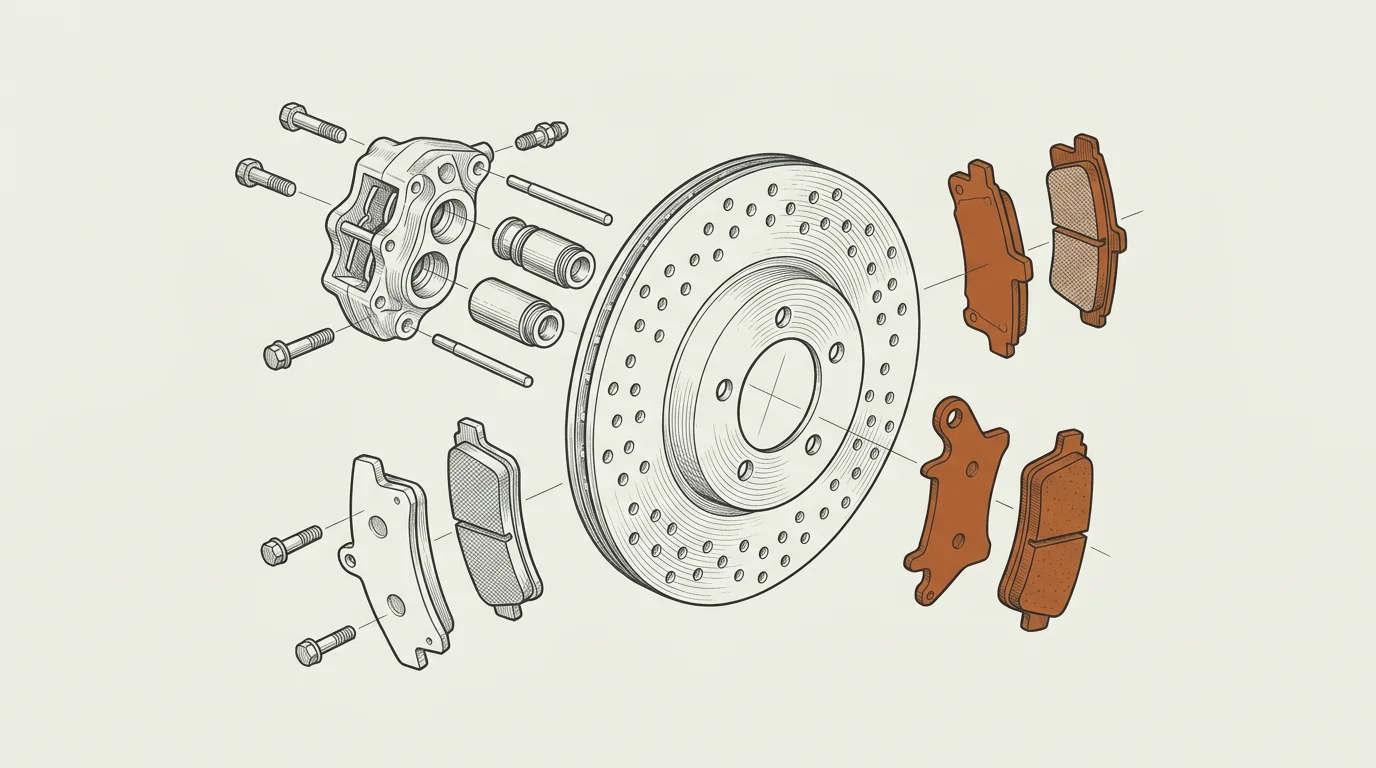
Brake Pad Compounds Decoded: Organic, Sintered, HH, and Race
Updated July 2026What EBC’s own catalogue and SAE J866 actually say about pad compounds — and the manufacturer’s own words on why race pads don’t belong on the street.
The compound families, plainly
Four families cover almost everything sold for street and track bikes, per EBC’s US Motorcycle Catalogue. Organic/NAO (aramid-based) is the only class Ferodo rates for use on cast-iron rotors, and it’s generally the gentlest on the rotor itself. Semi-sintered (EBC’s “V” line) blends in roughly 30% copper for more bite while staying street-friendly. Sintered HH uses a full copper-sinter compound, holds consistent friction wet or dry, and is what most ECE R90-approved sport-touring and sportbike OE pads use. Race compounds sit in their own tier entirely — EBC’s own GPFAX line is rated around µ 0.6–0.7, its EPFA line is a street-legal step-down from that, and SBS markets its Dual Carbon and Sinter race compounds explicitly “FOR RACE USE ONLY.”
What “HH” actually means (and doesn’t)
“HH” is an SAE J866 edge code, not a wear or quality rating — SAE’s own standard cautions against reading it that way. The two letters describe cold and hot friction coefficients on a fixed lettered scale (E = 0.25–.35, F = .35–.45, G = .45–.55, H = above .55): the first letter is the cold-friction band, the second is hot. “HH” means both numbers land above 0.55. It tells you nothing about noise, dust, longevity, or rotor wear — those live in the compound’s actual formulation, not its edge code. Treat “HH” as one useful data point, not a synonym for “best.”
Race pads on the street — read the manufacturer’s own words
This isn’t editorial caution — it’s the manufacturer talking. EBC’s own product page for its GPFAX race compound states it’s a “closed circuit use pad only,” and that “street/highway riding with this material is highly inadvisable and dangerous,” “NOT for use with highway tires.” Full race compounds also generally aren’t R90 or Tuv approved, which makes them illegal for road use in many countries outright, separate from the safety argument. A street-legal sintered or EPFA-class pad is the manufacturer-sanctioned track-day choice; full race compounds are for when the pad itself is your limiting factor — and for most riders on street tires, it isn’t yet.
Bedding new pads correctly
New pads are safe to ride on immediately, but they’re not at their best for roughly 400–600 miles as the friction surface transfers material onto the rotor evenly. Two habits matter more than the mileage window itself: pump the lever a few times before you move the bike after a pad change (the first stroke after a change does nothing — pads start retracted), and ride the first 100 miles — 300 if the rotors are new too — with deliberately gentle braking rather than one hard stop (EBC’s fitting and bedding guidance).
Fitment: pads fit calipers, not bikes
This is the detail that trips up more buyers than compound choice ever does. Pad shapes are numbered per caliper, with the compound as a suffix — FA380 versus FA380HH versus EPFA380 is one shape, three compounds. That’s why one shape number can span very different bikes, and why the same model can change shape mid-generation: the R6 moved from FA252 to FA380 between 2004 and 2005, while the R6S kept FA252 through 2006–09. FA379 alone covers the GSX-R600/750 (2004–10), GSX-R1000 (2004–11), ZX-10R (2008–15), and Hayabusa (2008–12) — four different bikes, one caliper shape. FA447 is “the Brembo radial monobloc pad,” shared across RSV4/Tuono V4 and other Brembo-monobloc-equipped bikes (EBC US Motorcycle Catalogue #304). Buy by caliper and confirmed year, not by bike name alone.
Questions riders ask
Is a sintered pad always better than an organic one?
No — “better” depends on the rotor and the use case. Sintered HH pads hold consistent friction wet or dry and suit sport and sport-touring calipers well, but some rotor manufacturers (Ferodo, for cast iron) restrict which compound their rotors are rated for. Organic pads are gentler on rotors and remain the only class Ferodo rates for cast iron. Match the compound to your rotor manufacturer’s own guidance, not a blanket “sintered wins” rule.
Can I run EBC GPFAX (or similar race pads) on the street?
EBC’s own product page says street/highway use with GPFAX is “highly inadvisable and dangerous” and explicitly not for highway tires — that’s the manufacturer’s language, not ours. A street-legal sintered or EPFA-class pad is the sanctioned choice for street and track-day riding on street tires.
How do I know which EBC shape actually fits my bike?
Look it up by caliper, and by your specific model year — fitment splits mid-generation more often than you’d expect (the R6’s FA252-to-FA380 switch between 2004 and 2005 is a good example). A shape number that fit last year’s model isn’t guaranteed for this year’s.